Showing posts with label Ancient Egypt articles. Show all posts

Ancient Egypt Remedies for helping women in childbirth

Oct 29, 2011

Ancient Egypt Remedies for helping women in childbirth

In real life, Egyptian midwives seem to have used both medical and magical methods to speed up labour. Medical remedies included swallowing a mixture of honey and fenugreek, or a vaginal suppository whose ingredients included incense, beer and fly dung. Spells of the second millennium BC for helping women in childbirth involve a variety of magical techniques, most of them similar to those used for treating diseases and minor accidents.
Identification with deities is often at the centre of these spells. The person helping the mother sometimes takes the role of Horus.

Read more...

Love, sex and birth in Ancient Egypt Papyrus

Love, sex and birth in Ancient Egypt Papyrus

Two curious fertility figurines from tombs at Beni Hassan are made of knotted string.
They were probably the physical component of spells involving the tying of magical knots. One seventeenth century BC pottery fertility figurine has an iron ring fitted tightly around its thighs.
Iron was a rare material at this date and the ring is almost certainly a magical binding device. The purpose of this charm may have been to prevent miscarriage by keeping the womb closed until the baby was due.
Alternatively, this figurine could be the relic of a malicious act of magic.
The iron ring might be there to prevent someone from giving birth easily. Without knowing what words were spoken to activate the figurine, its purpose must remain ambiguous.
As the time for the birth approached, the expectant mother was isolated from the rest of the household, or at least from its adult males.
One spell for 'hastening birth' summons Hathor to bring the sweet north wind to the pavilion in which the birth is taking place. Painted ostraca show women suckling children in an airy pavilion whose columns are wreathed with columbine or bryony

Read more...

Ancient Egypt Fertility Magic guide

May 13, 2011

Ancient Egypt Fertility Magic guide
Block from a tomb at Giza, c. 2300 BC. In the middle of a procession of female dancers and young boys stands a figure masked like Bes who holds a scourge and a hand-shaped wand. This unusual scene has variously been interpreted as a puberty ritual, a harvest festival, or a protective rite.
In Egyptian religion, the fertility of animals and crops was chiefly associated with male deities, such as Osiris, Amun-Min and the earth god Geb, but human fertility was more the domain of goddesses, such as Hathor, Isis, and Heqet. A snake goddess called Renenutet was linked to both human and crop fertility'.
Renenutet is often shown suckling a divine or royal child and was revered as 'the nourisher of children'. She was also the 'Lady of Granaries'. Renenutet was honoured in shrines set up in granaries and in the fields at harvest time.

Read more...

NOTABLE ARCHAEOLOGISTS George Andrew Reisner (1867–1942)

May 12, 2011

NOTABLE ARCHAEOLOGISTS George Andrew Reisner (1867–1942)

A leading twentieth-century archaeologist, Reisner, an American, excavated at Giza where he uncovered the Old Kingdom nobles’ tombs, the Valley Temple in Mycerinus’s pyramid complex, and the intact tomb of Queen Hetepheres. He also led the Archaeological Survey of Nubia (1907–1908), established a basis for Nubian prehistory, and explored the pyramids and sites in the Sudan, thus expanding knowledge of the Kushite rulers who conquered Egypt in Dynasty
He worked at the Egyptian Museum in Berlin, and later held the professorship of Egyptology at Harvard University (1914–1942). He was also curator of Egyptian antiquities at the Museum of Fine Arts, in Boston.

Read more...

NOTABLE ARCHAEOLOGISTS William Matthew Flinders Petrie (1853–1942)

NOTABLE ARCHAEOLOGISTS William Matthew Flinders Petrie (1853–1942)

Petrie, who received no formal education, was taught surveying and geometry by his father.
He first visited Egypt in 1880 to survey the Great Pyramid at Giza and then excavated for the Egypt Exploration Fund from 1884 to 1886. His considerable talent and ability were recognized by the novelist Amelia B. Edwards, one of the founders of the Egypt Exploration Fund (now known as the Egypt Exploration Society).

Read more...

NOTABLE ARCHAEOLOGISTS Giuseppe Passalacqua (1797–1865)

NOTABLE ARCHAEOLOGISTS Giuseppe Passalacqua (1797–1865)

Born in Italy, Passalacqua became an excavator and a collector after an unsuccessful stint as a horse dealer, the business that had originally taken him to Egypt. His excavations at Deir el-Bahri, on the west bank of Thebes (Luxor), from
1822 to 1825, revealed the tombs of priests and priestesses of Amun.
When he offered to sell his collection, drawn from Thebes and other sites, to the French government, it was rejected, but most of it was then acquired by Frederick William IV, ruler of Prussia, for Berlin’s Egyptian Museum. Passalacqua became conservator of the Egyptian collections at the Berlin museum in 1828 and spent the rest of his life there, organizing the material he had excavated.

Read more...

NOTABLE ARCHAEOLOGISTS Gaston-Camille-Charles Maspero (1846–1916)

May 11, 2011

NOTABLE ARCHAEOLOGISTS Gaston-Camille-Charles Maspero (1846–1916)

A French Egyptologist of Italian parentage, Maspero first led an archaeological expedition to Egypt in 1880. The next year, he succeeded Auguste Mariette as director of both the Egyptian Museum in Cairo and the National Antiqui-ties Service. He further developed Mariette’s work, expanding the excavation and temple restoration programs and continuing the organization and cataloging of the collections in the Cairo museum.
He is particularly noted for publishing the first edition of funerary spells known as the Pyramid Texts.

Read more...

NOTABLE ARCHAEOLOGISTS François-Auguste-Ferdinand Mariette (1821–1881)

NOTABLE ARCHAEOLOGISTS François-Auguste-Ferdinand Mariette (1821–1881)

Mariette became professor of Egyptology in Boulogne, France, in 1843 and first went to Egypt in 1850 in order to obtain manuscripts for the Louvre in Paris. On this visit, he became interested in archaeology and made the spectacular discoveries at Saqqara that launched his career as an excavator. In total, he uncovered some 7,000 principal monuments.

Read more...

NOTABLE ARCHAEOLOGISTS Walter Bryan Emery (1903–1971)

NOTABLE ARCHAEOLOGISTS Walter Bryan Emery (1903–1971)

Inspired as a youngster by public lectures given in Liverpool, England, by the Egyptologist John Garstang (1876–1956), Emery first went to Egypt in 1923. He became the director of excavation at North Saqqara in 1935 and there under- took one of his major projects, the almost complete excavation of the site’s Dynasty 1 cemetery.

Read more...

NOTABLE ARCHAEOLOGISTS Bernardino Michele Maria Drovetti (1776–1852)

NOTABLE ARCHAEOLOGISTS Bernardino Michele Maria Drovetti (1776–1852)

An Italian diplomat who fought in Napoleon Bonaparte’s army in Italy, Drovetti rose to become French consul general in Egypt (1811–1814). An interest in Egyptology led him to build up an impressive collection of antiquities, employing local agents to excavate sites or purchase objects from other excavators.

Read more...

NOTABLE ARCHAEOLOGISTS Howard Carter (1874–1939)

NOTABLE ARCHAEOLOGISTS Howard Carter (1874–1939)

An English artist who received his archaeological training from William M. Flinders Petrie, Carter first worked in Egypt in 1891.
He was engaged at various sites by the Egypt Exploration Fund, and from 1904, he supervised Theodore Davis’s excavations in the Valley of the Kings. In 1909, he began to work in the Theban necropolis for Lord Carnarvon, and from 1917, he explored the Valley of the Kings on behalf of his patron, searching for an intact royal tomb. He was unsuccessful until November 1922 when he discovered the virtually complete tomb belonging to King Tutankhamun.
Carter and his team took ten years to prepare, pack, and transport the spectacular tomb contents to the Egyptian Museum in Cairo.

Read more...

NOTABLE ARCHAEOLOGISTS Giovanni Battista Belzoni (1778–1823)

NOTABLE ARCHAEOLOGISTS Giovanni Battista Belzoni (1778–1823)

An Italian sailor who traveled to England where he became a weight lifter at Sadler’s
Wells Theatre in London, Belzoni also designed hydraulic displays for public entertainment in England.
Later, on his travels in Europe, he was encouraged to take his expertise to Egypt to construct irrigation equipment.
Although this venture was unsuccessful, he came to the notice of the diplomat and collector of antiquities, Henry Salt, who employed him to augment his collection.

Read more...

How to use ancient Egypt magic Amulets part 7/7

How to use ancient Egypt magic Amulets part 7/7
Gold cylindrical pendant with granular decoration, c. 1900—1800
BC. These containers were used to hold written amulets or small objects used in protective rituals.
Amulets continued to be extremely popular with the living and the dead while Egypt was under Greek rule. These amulets are purely Egyptian in type but are found in a greater range of materials. Some of the finest specimens are in glass
In Roman Egypt, precious and semi-precious stones were frequently used to make amulets and many foreign motifs were introduced
Written amulets, in a variety of languages, were very popular. Some were long and complex; others consisted of a few divine names.

Read more...

How to use ancient Egypt magic Amulets part 6/7

How to use ancient Egypt magic Amulets part 6/7
Necklace from a burial at Hu, c. 2000—1800 BC. Among the amethyst and carnelian beads are several amulets, including two small hippopotamus heads in
felspar and a carnelian snake's head pendant.
The amulet may be linked to menstrual blood and its place in the creation of human life. Spell mentions the power of the blood of Isis, but promises general protection for the deceased. The spell is to be said over a red jasper tyet amulet anointed with the sap of a particular herb, strung on a pith cord, and placed at the throat of the deceased. The magic of Isis will then protect his limbs and the ways through the underworld will be open to him. The text ends with a warning that the spell should be kept secret and a promise that it really works. Such endorsements are common in the magico-medical papyri.

Read more...

How to use ancient Egypt magic Amulets part 5/7

How to use ancient Egypt magic Amulets part 5/7
Amuletic bangle in gold and silver, c. 2000-1800 BC. The protective symbols include wedjat eyes, djed pillars and ankh signs. Also shown are a turtle, snakes, baboons, falcons, hares and the horned mask of the goddess Bat.
The first half of the second millennium BC saw a great expansion of amulet types. Much amuletic jewellery of fine quality survives from this period. Cylindrical cases just large enough to hold a folded scrap of papyrus were made in precious materials These may have contained written amulets to be hung at the throat to perpetuate a spell.
Solid 'dummy' cases are also known. The shape alone was presumably enough to evoke the power of written magic.

Read more...

How to use ancient Egypt magic Amulets part 4/7

How to use ancient Egypt magic Amulets part 4/7
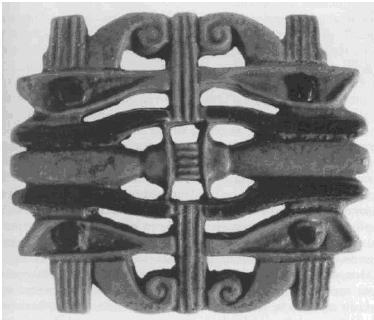
Multiple wedjat eye amulet in green and black faience, mid 1st millennium BC. The two pairs of divine eyes are separated by papyrus columns which symbolize growth and vitality.
Amulets were important to the Egyptians at all periods, but fashions in amulets changed. The use of amulets in Egypt goes back to the time before literacy. Around 4000 BC;, objects which archaeologists have classed as amulets start to occur in graves. It is impossible to be sure what such objects meant to the grave-owner. Among the earliest man-made amulets are small hippopotamus pendants in shell, ivory or stone
In later times, the female hippopotamus was a common amulet associated with the protection of pregnant women and young children.

Read more...

How to use ancient Egypt magic Amulets part 3/7

How to use ancient Egypt magic Amulets part 3/7
Steatite figure of a young girl holding a kohl pot, 19th-18th centuries BC. She wears a cowrie-shell girdle and has a fish amulet suspended from her plait.
Many amulets are closely related to the hieroglyphic script. This script is made up of signs which represent sounds (logograms), and signs which represent ideas (ideograms).
The ankh sign writes the word for life. The ankh as an amulet bestows or lengthens life.
The origins of this famous symbol are much debated. One suggestion is that it represents a penis sheath.1 If this is correct, the meaning of this symbol would be derived from the image itself.
Others maintain that the ankh represents a sandal strap, an object whose name happened to resemble the word for life. If this is the true explanation, the power of this symbol as an amulet would derive entirely from its written meaning.

Read more...

How to use ancient Egypt magic Amulets part 2/7

How to use ancient Egypt magic Amulets part 2/7
Part of The Book of the Dead of Ankhwahibre, c.6th century BC. It shows the main amulets used on a mummy and the spells that went with them. Next to the mummy (far right) are the djed pillar and the tyet knot. Thoth (left) is opening the gates of the underworld to let in the four winds.
Most amulets were intended to transfer to the wearer a particular quality of the being or object portrayed.
Some pendants in the form of deities may have been worn by pious people who wished to express their devotion to a particular god or goddess, but amulets use the power of a divine image in a more specialized way.
The gods and goddesses who were popular as amulets were not necessarily those who dominated the cult temples.

Read more...

How to use ancient Egypt magic Amulets part 1/7

How to use ancient Egypt magic Amulets part 1/7
Part of The Book of the Dead of Ankhwahibre, c. 6th century BC. It shows the main amulets used on a mummy and the spells that went with them.Next to the mummy (far right) are the djed pillar and the tyet knot. Thoth (left) is opening the gates of the underworld to let in the four winds.
The use of amulets is probably the most famous aspect of Egyptian magic. Egyptian amulets were exported or copied all over the ancient world. Huge numbers survive. One catalogue divides them into 275 main types, but that is probably an underestimate. Burials of the Egyptian elite include specially made amulets in precious materials
The function of some of these amulets is described in funerary literature such as The Coffin Texts and The Book of the Dead
The amulets found in humbler graves are more likely to be those worn by the deceased in life
They could go on helping and protecting the deceased in the afterlife. As with other intimate possessions, such as cosmetic kits and hairpieces, these amulets were probably considered too personal to be passed on to anyone else.

Read more...

Animal Mummies OF ANCIENT EGYPT

May 10, 2011

Animal Mummies OF ANCIENT EGYPT

Most scientific research has concentrated on human mummified remains, but there have also been some studies on animal mummies.
The Egyptians worshiped many of their gods in the form of animals, and some gods could appear in the guise of different animals. Originally, most gods were depicted with complete animal forms, but by the early historical period (c.2900 BC), many of them had acquired some human characteristics so that they now possessed human bodies attached to bird or animal heads.

Read more...

Powered by FeedBurner

Our Blogger Templates

  © Blogger template The Professional Template II by Ourblogtemplates.com 2009

Back to TOP